


Does using calculators make us worse at math? This was the question being asked in the 1980s during the Great Calculator Debate.
This was a fierce argument about whether letting children use calculators in elementary school was a bad idea. Opponents of the practice suggested doing so would lead to the “destruction of student math skills.”.
The pro-calculator forces won the debate, but the conversation about whether using computers erodes cognitive capabilities continued over the decades. When GPS gained widespread adoption, people lost their ability to navigate using maps, or even using landmarks. Google use has been associated with less ability to remember or retain facts.
Conversation about the cognitive impacts of computer use has intensified with the rise of AI in the form of large language models (LLMs). What makes LLMs different is their reasoning capabilities. They can debate, summarize, restructure and write for us. And, like other useful technologies, people are adopting AI to help with a cognitively challenging tasks such as writing. So, does AI use positively or negatively impact our skills and cognitive abilities?
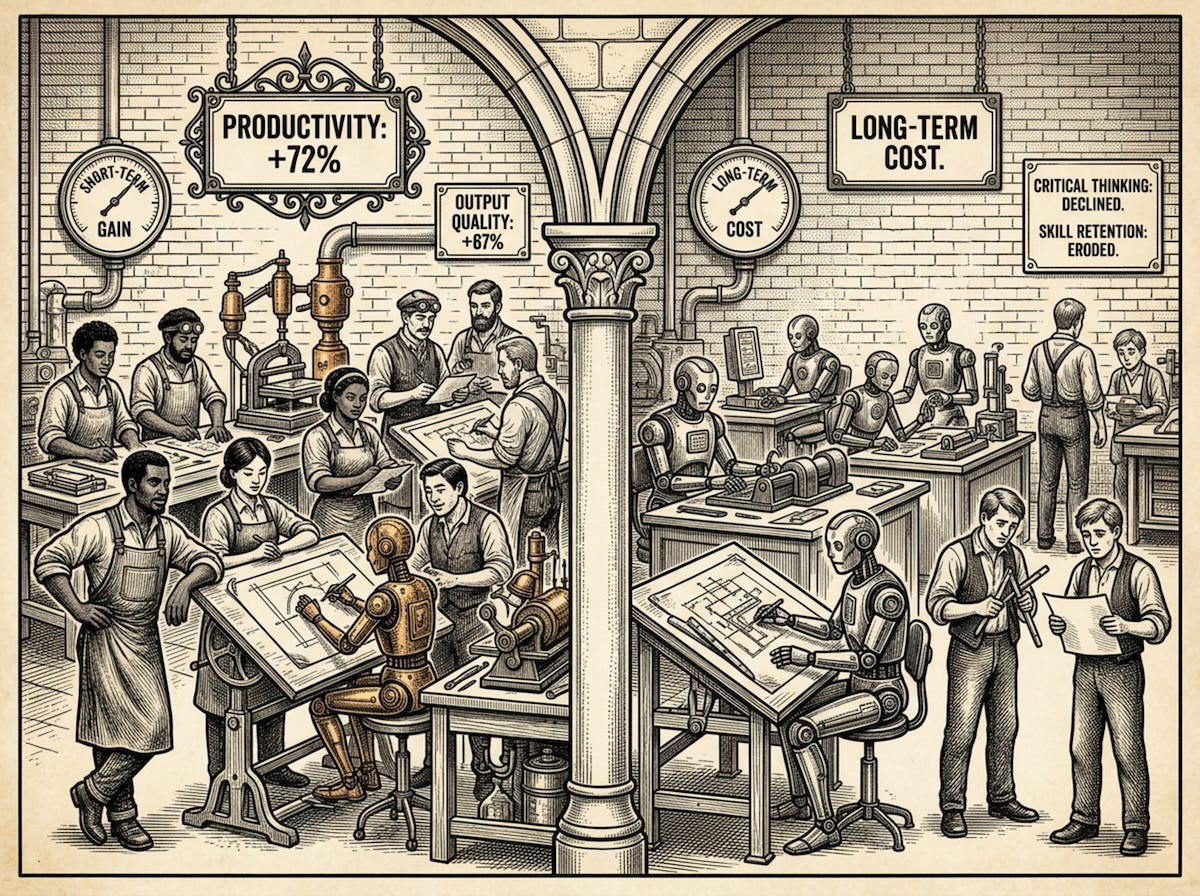
Recent analysis by Mark Keith of BYU suggests the answer is nuanced. Over the short-term there is a real benefit to AI use (when compared with non-users). AI users out-performed non-AI users in:
Productivity: 72% increase in task completion speed
Output quality: 67% increase in content output quality
Creativity: Writers given access to generative AI for story ideas created better stories (but story idea diversity declined)
Learning: 75% improvement in learning activity (during AI-delivered lessons)
However, these benefits don’t persist over the long term:
Skills gained during AI-delivered lessons decline
Many people forget what they learned when AI assistance is removed
People experience reductions in critical thinking skills, mental effort and learning retention
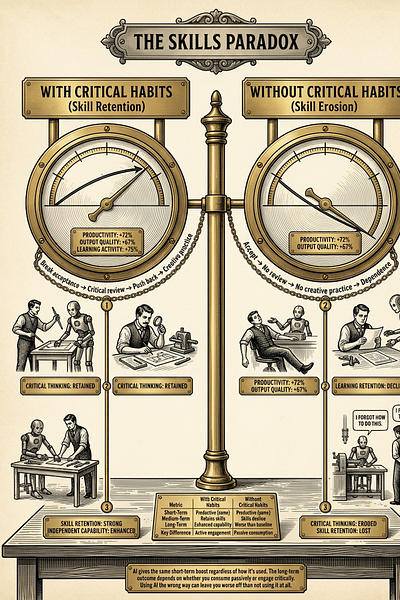
Keith suggests there’s a real gap emerging between those who can use AI and retain critical thinking skills and those who do not. In fact, he suggests using AI the wrong way could leave AI users worse off in key ways than those who never started using AI in the first place.
I agree.
How to Retain Cognitive Skills While Using AI
Many of the ways people tend to use AI are sub-optimal for retaining critical thinking and other skills. Keith’s research and my experience in this are suggests the best ways to thrive long-term while using generative AI is to:
Break the Acceptance Pattern: Resist the urge to ask AI for an answer and accept it on face value
Be a Critical Consumer: When AI provides any output, especially if it’s high-stakes, critically review it for correctness, validity and rigor before accepting it
Ask AI to Push Back: This is especially important in engineering tasks where there might be a better and more elegant way to solve a problem
Keep your creative edge: Remember that AI tends to produce outputs that are at the average rather than out-of-the-box. Spend time coming up with concepts, and ideas without AI assistance.
Practicing thee habits over the long-term can be difficult. Extended AI use, especially if the results are generally of good quality, breeds complacency. But, it’s the practice of remembering that generative AI outputs can be of wildly uneven quality. Doing so will keep you on your toes. Just because an answer is correct in one context does not mean it’s valid in another.
This newsletter is part of the Doing AI Efficiently Operating System, built on five operational layers: Grasp, Discern, Ward, Execute, and Honor. This essay is part of the Execute layer, which is focused on helping you use AI solutions better over the short- and long-term using education, tools and experiential learning.