


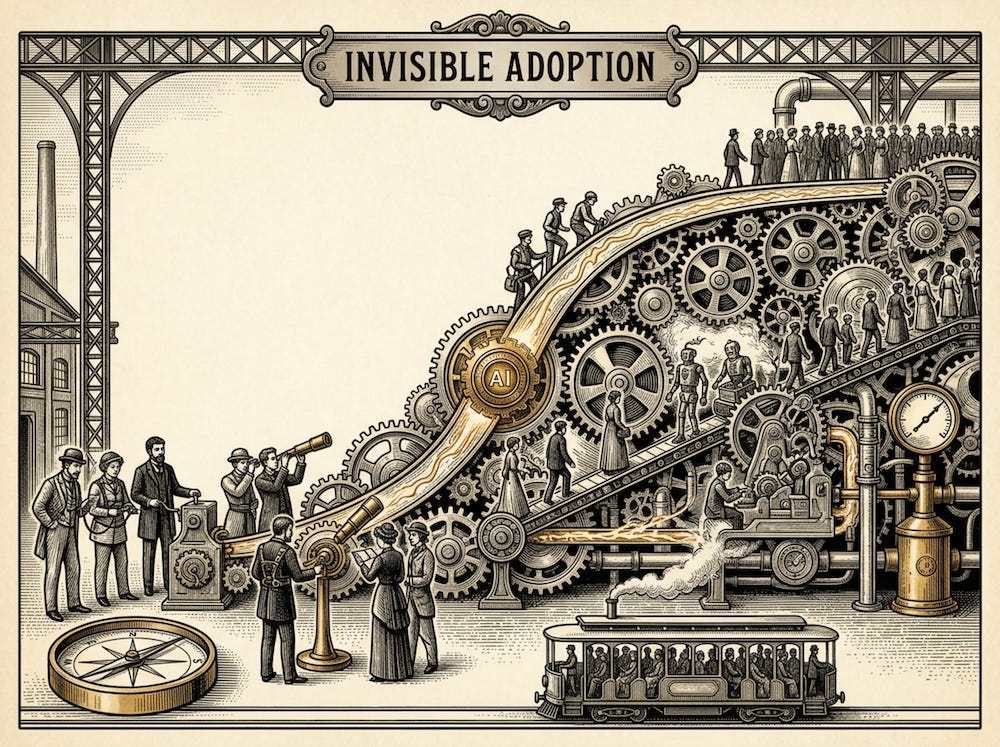
Over the last few years, Pew Research has been publishing new findings on how Americans are using AI. The headline from their latest research: about half of U.S. adults say they never use a chatbot, and most of them have no plans to start.
Pew also found many are skeptical, suspicious and worried. Most predict AI will have a negative impact on their lives. Majorities say AI technology is advancing too fast and has significant privacy risks.
Usually, when people are uninterested in using a technology and have negative feelings about it, it’s easy to conclude adoption will be slow and arduous. What’s more, tepid consumer interest in chatbots, and, more recently, AI Agents, are powerful signals that AI may be in an extreme bubble. After all, if people don’t want to use the tech, it may not worth the investment.
But, there’s something different happening with AI. The reasons why have everything to do with a huge technology transition that took place in the 1990s and the rise of ‘invisible’ AI.
How technology adoption usually plays out
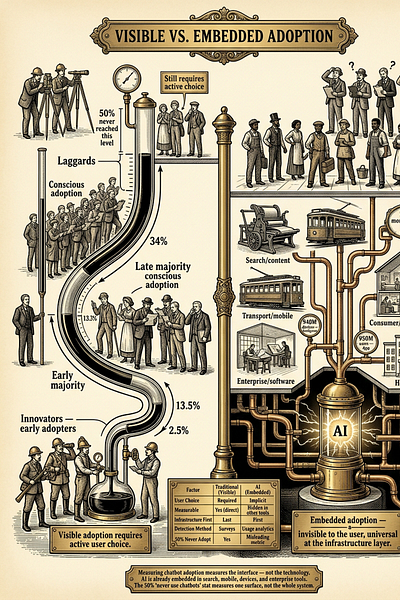
I’ve spent more than 20 years tracking (and living) technology adoption in a range of areas such as how builders adopted and reacted to AI’s use in coding. The famous adoption curve tells the tale. A small number of innovators and early adopters live at the bleeding edge. It can take a while for everyone else to catch up.
My lived example of this was in digital health, or the use of virtual reality, smart devices, wearables, artificial intelligence and other technologies in healthcare. I started working in digital health in 2005, focusing on the adoption of the Internet as a source for health and wellness information.
I then turned to mobile technology and other solutions. Broad adoption of digital tech broadly in healthcare took more than a decade. Patients were the innovators and early adopters. Organizations and government were (and still are) very slow.
There were many reasons for slow institutional adoption, including the need to prove digital health solutions are safe and effective, figuring out how to pay for them, and creating regulatory and legal processes.
Interestingly, AI has been in healthcare for a long time. Adoption wasn’t really any faster, because trusting an AI to diagnose diseases like cancer is orders of magnitude harder than relying on it to analyze a financial document.
Ultimately adoption comes down to infrastructure: regulatory, technical and legal. There’s another area where infrastructure played a major role in adoption: The Internet.
The rise and fall of (and rise again) of the Internet
It’s the question on everyone’s lips right now: are we in an AI bubble? The comparisons are stark. The dot-com boom was characterized by extreme exuberance. Many believed that the Internet, which had finally gained traction, and mobile technologies would usher in a golden age of major digital, societal and economic transformation.
At the same time, the cost of transmitting data fell as fiber optic cables were installed. Global Internet use increased and many investors thought bandwidth demand would grow exponentially. Telecom firms and startups accelerated their efforts to install fiber optic cables and increase wireless capacity.
The problem was supply versus demand. Although Internet traffic was increasing, the last mile problem persisted. Many Web users were unable to take advantage of fiber optic capacity, which meant download times were slow and frustrating. Fiber optic may have been under the street, but getting it into homes was a whole other problem.
In 2000, about 1% of U.S. adults subscribed to broadband. About 34% of Americans were on dial-up. Only 43% of Americans used the internet at all.
The last mile problem had a negative impact on Internet commerce as consumers couldn’t buy what they couldn’t access, and demand was much lower than expected.
Many publicly traded Internet companies had negative cash flows. Telecom companies had buried some 80 million miles of fiber across North America and Europe, but 95% of it may have been dark, i.e. not carrying data.
Markets were pricing a fully-formed, fast-moving digital economy. But when credit tightened after Fed interest rate hikes, and investors began to shift their portfolios from Internet stocks, disaster struck. In March 2000, the Nasdaq hit its highest rate ever, by April, it had lost a high percentage of its value. Dot-com and telecom companies that had taken on massive debt or had no cash reserves (and limited revenue) failed.
Despite this massive failure, the boosters were right: the Internet did change everything. Web commerce became commonplace. Demand for fiber optic exploded. Just not on the timeline everyone assumed.
What big tech internalized from the dot-com crash
The dot-com bubble burst is seared into the memories of everyone who lived through that era. And, it’s shaping the strategic decisions of big tech companies.
First, just like in the dot-com era, companies are spending huge amounts on infrastructure. In 2026, Amazon, Microsoft, Alphabet and Meta are on pace to spend roughly $725 billion on on AI infrastructure, up 77% from 2025’s $410 billion.
Where are they getting the money? Some of it is coming from cash on hand. Alphabet reported its first-ever negative free cash flow quarter in Q2 2026, driven by $44.9 billion in capex in a single quarter. Its full-year free cash flow is projected to fall roughly 90%, from $73.3 billion in 2025 to around $8.2 billion. Amazon is projected to turn free cash flow negative as well. For every additional dollar these companies generate in operating cash, they are spending approximately $1.57 in capital expenditures.
The invisible AI adoption curve
Are companies and investors making the same mistake of the dot-com era: over-investing in a technology where demand is lagging? The Pew chatbot stat is measuring one visible surface of AI that requires proactive engagement. Someone choosing to use a technology featuring an AI agent is another active choice.
The Internet has always required active engagement. People choose whether to go online, they decide to call up the cable company to have fiber optic installed, they have to visit a Website to make a purchase.
AI is different because it is being embedded into technologies that people are using already. Google, Apple, Meta and other big tech firms aren’t waiting for people to demand AI. They’re giving people no choice but to use it.
Google AI Overviews in search now have 2 billion monthly active users across more than 200 countries and 40 languages. This has transformed search engine marketing. The focus is now on how to be mentioned in AI search and cater to Internet-roaming AI bots. Consumers are adopting AI agents. They just don’t know it.
Embedment is going even further, the Gemini app has nearly 950 million monthly users as of Q2 2026. Apple Intelligence is active on 940 million devices, with 410 million daily active users.
Pew’s research reveals that the general public thinks AI means Chatbots. The reality is that AI is ... everything. And, because it’s embedded in search, mobile phones and other ubiquitous technologies, it’s already powering people’s most consequential decisions. (Side note: I started talking about technological embedment back in 2014 as it relates to digital health tech adoption (which was slow at the time).
The next embedment push is in hardware. In 2025, AI-capable chips were in 35% of all smartphones shipped globally, up 74% from the prior year. AI PCs are projected to cross 50% of the global PC market in 2026. Amazon says 97% of all devices it has ever shipped can now support Alexa+.
People are noticing the AI seems to be everywhere. According to Pew 40% of U.S. adults say they engage with AI at least several times a day. 63% are concerned AI is moving too fast.
Yes, 50% of Americans never use a chatbot.
But, they’re using AI agents, reading AI content and much more. They just don’t call it AI. They call it search, using a computer or operating a mobile device.
AI and work: The next chapter
Pew found that roughly four in ten employed adults under 50 already use AI at work, and that number is likely to increase. A few months ago, many were talking about how AI was going to replace workers. And, in some cases they will. But, leaders are realizing that large language models are nowhere near ready to replace workers. So, they have to figure out how AI can augment work. And employees will need to understand how to use AI effectively.
What you should be focusing on now.
Stop asking the AI bubble question. It’s irrelevant
I think some people asking whether AI is in a bubble are looking for an excuse to ignore or dismiss it. AI is already ubiquitous, and is being used in everything from coding, to writing, search and mobile.
Moreover, although Anthropic and OpenAI capture much of the attention, I believe the companies best positioned to survive market declines are Goggle and Apple. They are well-positioned to buy bankrupted companies and assets.
Remember: AI Agents are infrastructure
At their core, AI agents are not complex. They are LLMs armed with tools being pointed toward tasks. They are capable of complex decision-making, which is what makes them valuable in situations that require nuance and judgment.
Although some people are productizing AI agents, I don’t see consumers buying many of them. Instead, they’ll purchase a service where agents will be embedded. Unless something goes wrong, they won’t notice them.
People need to be trained how to use AI
AI will be everywhere and people will be expected to understand what it is, how to use AI well and the ways AI can be used to augment rather than diminish cognitive capacity.
All of this will require training. Those who get ahead of the curve will benefit the most.
The 50% who say they’ll never use a chatbot aren’t wrong. Chatbots are a user interface. Why seek one out if you don’t need it?
AI however, will be everywhere. And people know it. How people adapt to these tools will be the adoption story to watch.
This newsletter is part of the Doing AI Efficiently Operating System, built on five operational layers: Grasp, Discern, Ward, Execute, and Honor. This essay is part of the Grasp layer, which is focused on helping you understand how AI works from first principles, including tokens, context windows, model architecture, how LLM content generation happens, AI adoption trends and more.
Really nice article Fard, so nice I will Sub. AI adoption isn’t waiting for everyone to open ChatGPT and have an epiphany. It’s being quietly bolted into the stuff they already use.
Search. Phones. Software. Workflows.
You can say you “don’t use AI” and still be using it ten times before lunch without knowing it. I think that feels far more important than the chatbot adoption numbers. The interface might change completely. The underlying shift probably won’t.