


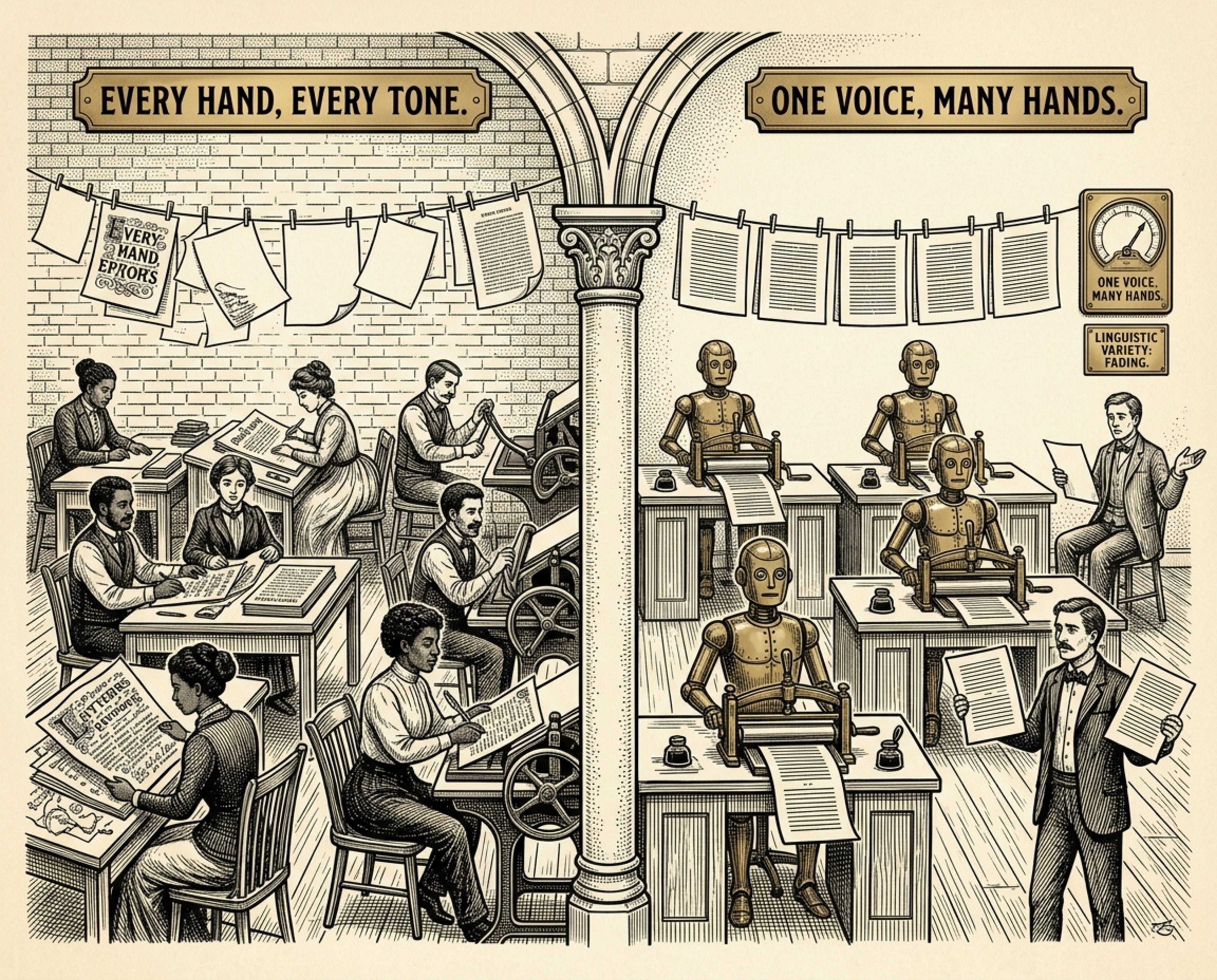
Welcome to the first installment of the AI Research Beat. This is a regular series where I highlight an interesting study that sheds light on how AI is impacting work.
Writing is tedious, horrifying drudgery. It’s also rewarding and gratifying. But, you have to get past the hard parts first.
Is it any wonder that large language models (LLMs) have been welcomed by writers all over the world? Staring at a blank page? Ask Claude to help you get started. Struggling over word choice? ChatGPT is there to lend a helping hand.
I’m not against people turning to AI for writing help. Some may not be fluent English speakers. Others may have limited writing experience, or simply need a lot of assistance.
Then there’s using AI writing out of necessity. For example, I’m creating an AI educational skill building game called Clankyopolis. Players will learn by working through customized scenarios, generated on-demand. There’s no way I can write every word of the game’s copy. LLMs to the rescue.
But, there’s a problem with uncritically using LLMs for writing. Your unique voice is snuffed out. People complain your writing is flat. They’re right.
According to a new paper, “The Shrinking Landscape of Linguistic Diversity in the Age of Large Language Models,” by Zhivar Sourati of the University of Southern California and colleagues:
Language provides valuable insights about people’s mental health, behaviors, and health status
LLMs are eliminating this rich linguistic intelligence
Generative AI models “homogenize writing styles,” making content less diverse and interesting
When LLMs are used to '“polish and rewrite texts,” textual diversity and uniqueness decreases (translation: it’s boring)
LLM text sounds like it was written by older liberal males; unique ethnic or cultural language traits are erased
As shown in the infographic below, since the advent of ChatGPT, writing complexity and diversity across ArXiv, Path Notes and Reddit declined sharply.
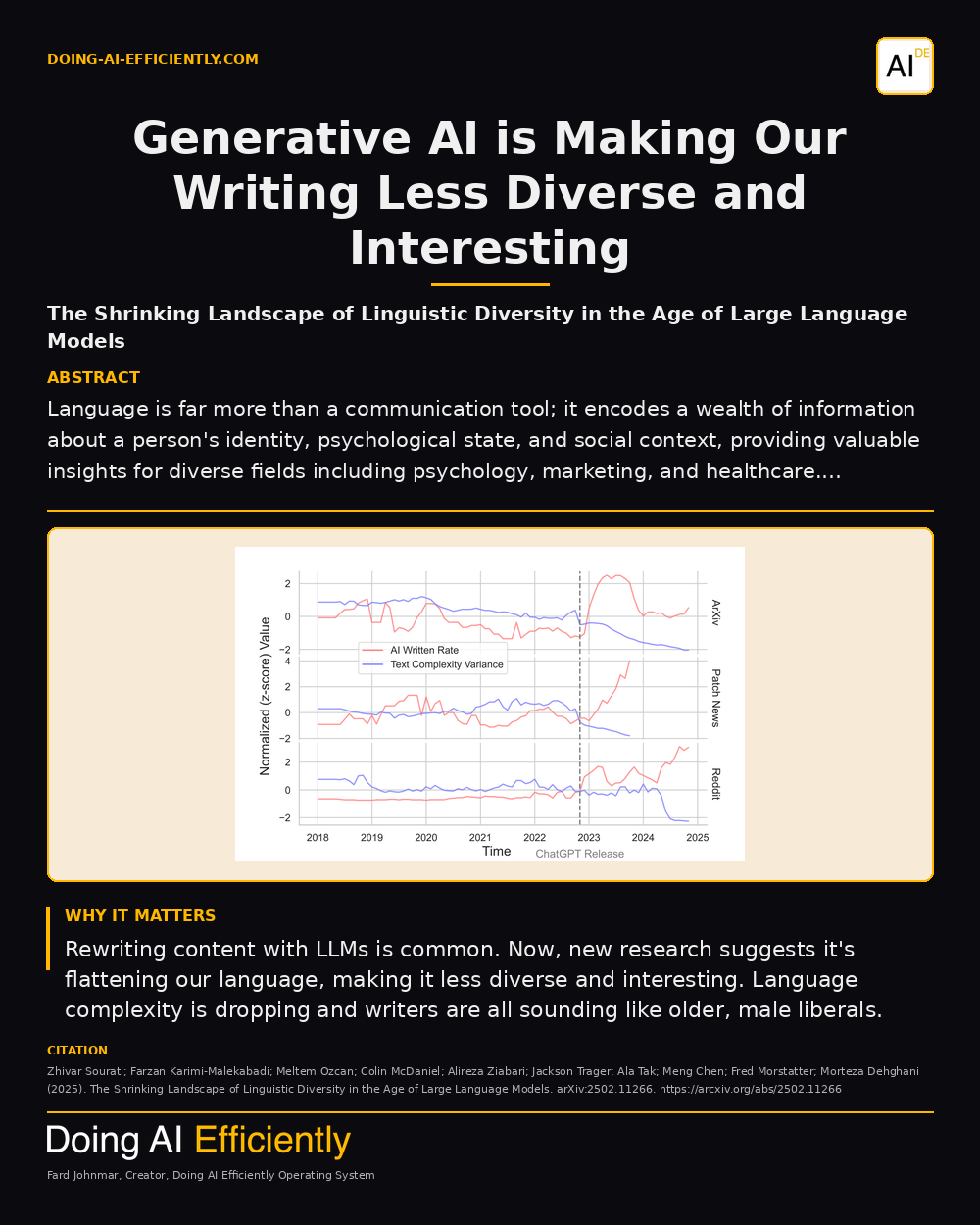
(Thanks to Sekoul Krastev of The Decision Lab for highlighting this study on LinkedIn.)
It’s All in the Edit
Generative AI is making our writing less diverse and terribly boring. What can we do about it? The answer isn’t shame or ridicule. People aren’t going to stop using AI to help them write.
Instead, people need to learn how to edit their AI-assisted content. Proper editing can retain a writer’s unique voice while increasing content accuracy and impact.
It’s popular for people to use ‘humanizing’ skills to remove obvious AI tropes from writing. This isn’t enough. The problems with AI-generated prose go way beyond removing em dashes and “it’s not X, but Y” phrasing. Improving AI writing requires a human touch.
I’m currently working on an online course, Beyond the Em Dash: How to Edit AI Writing Effectively. My course will feature guidance on how to deal with common AI writing weaknesses. Here are five tips from the course you can put to work right away.
AI writing is wordy: Get to the point. Cut unnecessary fluff.
AI copy is weak: Saying “nobody does X” is a cop out. Write with power. Use percentages, or specifics.
AI copy is plagued by throat clearers: Phrases like “it seems like” add nothing. Delete them.
AI copy is fearful: Descriptive, potent writing holds the reader’s attention and doesn’t waste their time.
AI-assisted writing is making everyone sound the same. Writing with purpose, power and precision (and having good editing skills) will put you ahead of the pack.
This newsletter is part of the Doing AI Efficiently Operating System, built on five operational layers: Grasp, Discern, Ward, Execute, and Honor. This essay is part of the Discern layer, which focuses on helping you develop and practice good judgement when using AI.
I do think part of the narrative around AI in writing does come from the publishing industry.
Long before 2022, traditional publishing had already transformed into a massive, risk-averse machine. Major houses spent years consolidating, killing off the mid-list entirely and deciding that taking a chance on a weird, genuinely original manuscript was a financial sin. They stopped betting on art and started betting on maths. That's why bookstore tables got buried under a mountain of ghostwritten celebrity memoirs, TikTok-core romance, and books backed by pre-existing massive email lists or follower counts. The industry taught everyone that reach and marketability matter infinitely more than the actual writing.
So when generative AI showed up, it didn't break a pristine, sacred creative ecosystem. It just handed the keys to a system that was already completely broken.
Is that the only issue? No. There are assholes out there who try to game the system! There are also really good ideas that AI has helped to refine. However, it does mean that the writing landscape has yet to agree on what good and bad is.