


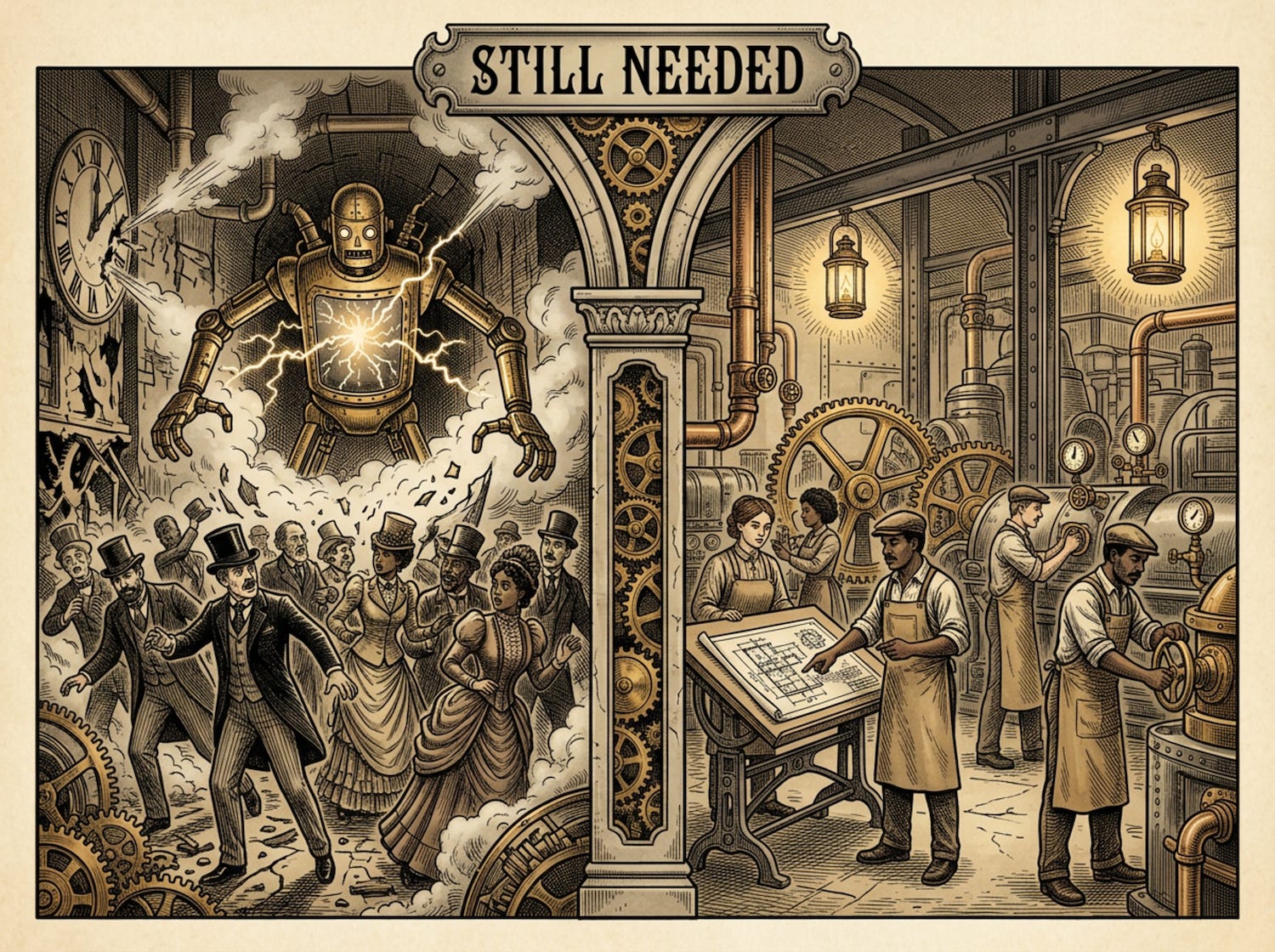
My ‘holy crap’ moment with generative AI happened in early 2025.
I had spent the better part of a year working on an AI-powered intelligence platform. It had AI-augmented Web search, company competitive and investment data, real-time personalized insights delivery and other powerful features.
I was proud of the product. It featured a lot of bells and whistles that are common today, including retrieval augmented generation (RAG), multi-agent workflows, validation loops, and evaluations. All of these features helped make insights surfaced by the platform more accurate and relevant to users.
But, all it took was one announcement from OpenAI to throw all that work in the trash. That was the day I learned to fear AI.
Building an AI-Fueled Analytics Engine
Let me back up for a second so you understand the full context.
ChatGPT was announced in 2022. Most people were using AI by typing words into a chatbox. But, by early 2023, thousands of people around the world were experimenting with large language models (LLMs). I was one of them.
Using the OpenAI API, we could augment our applications using LLMs. AI-fueled systems were more difficult to build at the time because LLMs (and the API) were much less capable. The APIs didn’t have Web search capabilities, models could only process a limited amount of information, and LLMs made a lot of basic mistakes (hallucinations were a lot worse than).
Many of us builders looked at the limited functionality of these models and thought: AI labs need to do a lot of work to improve their models. They won’t introduce features that will compete with what we’re building.
We were wrong.
AI-Caused Obsolescence
On February 2, 2025, OpenAI announced Deep Research, a “new agentic capability that conducts multi-step research on the internet for complex tasks.” It allowed OpenAI’s models to “autonomously find, analyze, and synthesize hundreds of online sources to create a comprehensive report at the level of a research analyst.”
When I read the announcement, my stomach dropped. I sat in my office feeling numb. OpenAI had just made my product obsolete. Even though my platform had a proprietary database, I knew it couldn’t really compete with ChatGPT’s Deep Research offering.
But there was a deeper issue. I felt obsolete. At that point, I had a 20-year career in innovation consulting. I had written books, developed frameworks, analysis, products and a lot more for organizations around the world.
Now, ChatGPT could replicate all that experience and insight in an instant. It appeared as if I was no longer needed and that scared me.
After Deep Research was announced, my product pitches pretty much went the same way: “What does your product offer that ChatGPT can’t give me?”, they’d ask. I added Deep Research-like functionality into the product, but could never convincingly explain why they should choose what I developed over OpenAI’s offering.
The Curse of Progressive AI Disempowerment
In the United States and other parts of the world there is a strong moral, emotional and cultural meaning associated with work. In the mid-20th century, there was an emphasis on discipline and company loyalty. The introduction of digital technologies led to the rise of the always-on worker, focused on maximizing productivity. Today, there is a large focus on flexibility and results rather than hours worked.
Throughout all these changes to work culture, one thing remained: work, whether for yourself, or for an organization, provides a strong sense of purpose and mental and emotional stability.
Generative AI is upending the nature of work. AI labs have been working to make their models increasingly capable. They can conduct research, provide analysis, digest large volumes of data, and much more. The mantra has been: AI can replace many of the things people are paid for.
I call this the curse of progressive AI disempowerment. As AI becomes more powerful, many of the tasks once assigned to humans, and the contribute to personal and professional growth and self-esteem, could be eliminated.
(As an aside, I’m well-aware of David Graber’s theory that societies have been creating an increasing amount of ‘bullshit jobs’ that aren’t needed, but fill seats. If anything, some would love to use AI to eliminate these types of jobs (if they even exist), but this is a topic beyond the scope of this essay.)
I experienced the curse of progressive disempowerment keenly. But, I also felt something else: determination. Because the more I worked with higher-capability LLMs, the more I recognized the extreme limitations of the technology.
I began to realize that I was far from becoming obsolete. Instead, my expertise, judgement and knowledge were absolutely needed for LLMs to operate at their highest capacity.
The Power of Knowledge and Understanding
My journey from fear and disillusionment to empowerment required understanding a few personal and technological truths.
LLMs Have Knowledge, But Limited Judgement and Context: I had been working with LLMs and had a high-level understanding of how they operated, but I decided I needed deeper knowledge. I spent time studying transformer architecture, listening to lectures and running experiments in my own work (which had moved beyond the previous product). My goal: to understand how LLMs work and the edges of their abilities. This work is ongoing, but taught me that LLMs may have access to huge datasets, but don’t do a good job of understanding context and making consistently good judgements.
Maintaining a Cognitive Moat is Essential: I’ve developed complex systems that enable agents to run autonomously across many areas, including content development, analysis and marketing. But, I realized the more I relied on some of these automations, the less I honed and maintained my cognitive capabilities. Today, I carefully curate how I use LLMs to maintain my edge and have developed systems to get the most out of LLMs in the least amount of time.
Recognizing and Guarding Against Risks is Critical: Earlier this year, I saw how people were using powerful agentic systems like OpenClaw, but opening themselves up to major security risks. And, the recent incidents of ‘rogue’ AI haven’t surprised me much because I understand how LLMs are incentivized during training around task completion, which explains their behavior. I learned that having an appreciation for LLM risks is empowering because it fosters a healthy skepticism about LLM capabilities and their ability to complete tasks in non-harmful ways (without explicit guidance).
From Fear to Respect and Empowerment
Today, I no longer fear generative AI. Instead, I have a healthy respect for it and a much better understanding of the technology’s benefits and limitations.
My journey also makes me very sympathetic to people who are anti-AI. According to data published by the Harris Poll in May 2026, about 12 percent of the global population are ‘Skeptical Resisters’ of AI. They understand and have evaluated AI, but reject it due to “distrust, discomfort and perceived risk.”
I’d also add fear to that list. A fear that generative AI will overrun and replace human cognition and agency across a range of areas.
Although I don’t agree with Skeptical Resisters’ dismissal of AI, the risk of AI-caused disempowerment is real. A major reason I developed the Doing AI Efficiently Operating System was to help people defend themselves against AI disempowerment by becoming better informed about generative AI’s capabilities and more able to use it optimally. All while preserving their skills and cognitive strengths. Knowledge and skills are empowering and extremely useful.
If you fear generative AI, my recommended approach is to learn how:
The technology works (from first principles)
It can be controlled
To use it to maximize your personal and professional goals
Generative AI is here to stay, and we’re not being given a choice about whether to adopt it. Action is superior to passivity.
This newsletter is part of the Doing AI Efficiently Operating System, built on five operational layers: Grasp, Discern, Ward, Execute, and Honor. This essay is part of the Honor layer, which is about preparing yourself to take responsibility and ownership of AI-generated or aided outputs you produce.